
Angular Limb Deformities in Foals: Early Signs, Causes & Treatment Options
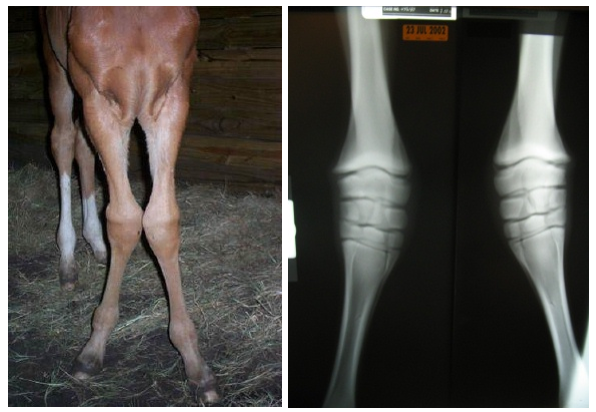
Photo of Angular Limb Deformities in Foal; Radiographs of Angular Limb Deformities
Angular limb deformities (ALDs) are developmental conditions in which a foal’s legs appear to angle inward or outward as they grow. These deformities are commonly described as either valgus (outward deviation) or varus (inward deviation), and are named according to the joint affected, such as carpal valgus (“knock-kneed”) or fetlock varus.
There are several reasons ALDs may develop, including rapid growth, uneven stress on growing bones, trauma, or prematurity. Premature foals are especially at risk because some of their bones may not be fully developed at birth. It is also important to recognize that not every “crooked” appearance is a true deformity.
Many young foals naturally stand with their toes turned outward due to normal limb rotation from the shoulder, and this often improves on its own as the foal matures. Early evaluation is extremely important. We often recommend radiographs (X-rays) to determine which bones and growth plates are involved and to assess overall bone development. Because growth plates eventually close, there is only a limited period when correction is most effective- especially in the lower limbs, where growth occurs rapidly during the first few months of life. Treatment depends on the foal’s age and the severity of the deviation. Mild cases in very young foals may respond well to conservative management such as controlled exercise, corrective hoof trimming, glue-on extensions, splints, or casts. More severe cases or those recognized later in development may require surgery to guide proper growth.
Fortunately, many foals with angular limb deformities can go on to live healthy, athletic lives when problems are recognized and addressed early. Prompt evaluation from your veterinarian and an individualized treatment plan offer the best chance for a successful outcome.